The Erased Protagonist
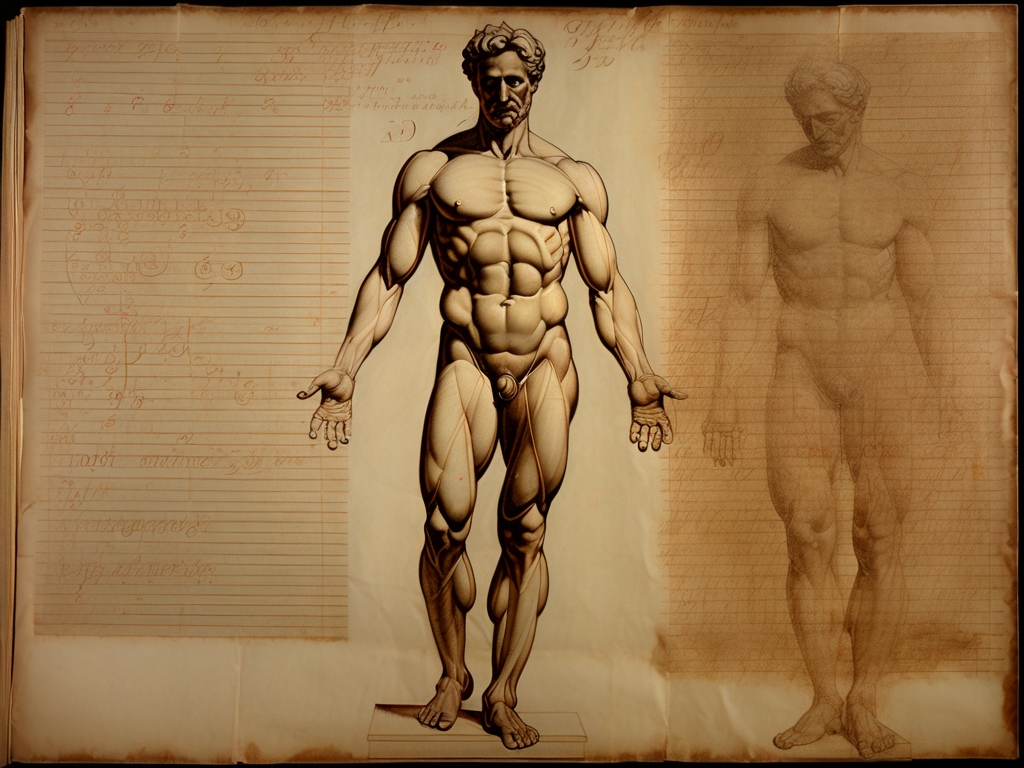
Within the shadowed recesses of the Ravensfield Collection’s manuscript wing hangs an enigmatic drawing that unsettles as much as it captivates. At first glance, one encounters a classical male figure study—an idealized torso sculpted with flawless neoclassical anatomy, poised upon a modest square pedestal. Yet the familiar gives way to the uncanny: where form should be resolute, it instead dissolves at the peripheries into faint typographical marks and cryptic numerical notations, whispering across the aged parchment like spectral echoes.
Grimault’s hand betrays an obsession that marries anatomical exactitude with literary architecture. Muscular limbs lose their corporeal integrity, bleeding imperceptibly into flowing script and faded marginalia. The head remains sharply rendered—a solemn mask of chiseled gravitas—yet even it ascends into nebulous chalk-like symbols that seem to dissolve skyward. Below, feet are rooted firmly on their base but fade gradually outward in diminishing strokes reminiscent of eroding footnotes receding into obscurity.
This mysterious drawing once belonged to Cornelius Thorne, a minor London novelist whose serialized tales of Captain Meridian graced The London Literary Gazette throughout the 1840s. Thorne discovered the piece in a dusty Parisian antiquarian's shop, noting with disquiet its unsettling resemblance to his protagonist's own physique.
Almost immediately after acquiring it, strange phenomena began infecting Thorne's manuscripts: scenes compressed into cryptic parentheses; dialogues truncated to ellipses; episodes contracted until reduced to mere annotations. Wilhelmina Blackwood, Thorne’s meticulous editor, logged each transformation with cold precision—the hero’s name shrinking from ornate chapter headings to fleeting mentions within marginal notes.
By late autumn 1847, Captain Meridian had vanished from narrative altogether, relegated solely to terse footnotes appended at episodes’ end. Readers found themselves adrift amid references without substance—adventures alluded to but never retold. Despite frantic rewrites by Thorne himself, each iteration deepened his hero’s retreat further into scholarly margins.
The final installment offered no story save for an exhaustive bibliography in which Meridian appeared only as cross-referenced citations and suggested reading—not as character but as academic artifact. Thorne’s private journals convey mounting dread: “The drawing devours my creation whole; leaves behind skeletal scholarship where flesh once lived.” He ceased writing thereafter—declaring his imagination “academically compromised.”
The artwork entered Ravensfield’s vault via acquisition agent Barnaby Whitmore-Hayes who procured Thorne’s estate following the author’s sudden disappearance in 1849—a vanishing echo mirroring that of his fictional champion.
"The piece demonstrates literature's capacity to devour its own creators." Dr. Evangeline Morse, Narratological Archaeologist
Present-day visitors speak uneasily of a compulsive urge to record their impressions—only to find their notes fractured into sparse technical observations and bibliographic listings. It is as though this singular image transmutes onlookers from witnesses into mere instruments of scholarly apparatus—a haunting testament to art that consumes narrative flesh and replaces it with endless annotation.